How Your Morning Coffee Reflects Your Taste, Mood And Style
The modern coffee ritual signals both intention – setting the tone for the day ahead – and also borrows from the language of fashion, where the cup, the setting and the moment itself are chosen as carefully as you would a great outfit. From brew to aesthetic, this is how to make your coffee routine more auspicious for your life. By NATASHA BIRD
In 2026, we are suspicious of anything that smacks of wellness theater. Whether it’s getting up at 4am to do a workout before your children have stirred, aesthetic matcha ceremonies in a kitchen that looks like a show home or a 16-product nightly routine with 20 minutes of gua sha, we’ve seen it, we’ve scrolled past it, maybe even flirted with the idea for a minute, before realizing it couldn’t possibly be sustainable. We’re as sceptical as we are eager about incorporating moments of ritual and wellbeing into otherwise hectic lives.
That scepticism isn’t misplaced, as Sofia Downing, founder of wellness brand Inora, points out: “When a subculture scales that fast, authenticity might be questioned. You start wondering who’s genuinely living it and who just arrived for the aesthetic.” Wellness, she suggests, hasn’t lost its real-life value, but it has been subject to the same trend cycle as everything else. “Something real gets picked up and amplified, then quietly dropped when the next thing comes along.”
And yet, in the maelstrom of back-to-back meetings, checking all of our devices, running between appointments and ferrying children around, carving out a moment of stillness and intention can be crucially rebalancing. A coffee ritual is a great place to start.
“We spend a lot of time trying to optimize for a future we never quite get to,” says Chris Deferio, coffee consultant and host of coffee-shop podcast Keys To The Shop. “A coffee ritual is a point of stability, reflection and clarity that is facilitated by making coffee – either in solitude or with others. It is more than habit. It is more intentional. Each part of the process is what makes it special.”
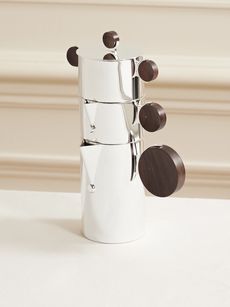 CHRISTOFLEGigogne silver-plated and wood coffee pot
 OLIVIA VON HALLEBella silk-satin pajama set$264.00View Product DetailsSelect a Sizex small - out of stocksmall - out of stockmedium - out of stocklarge - out of stockx large - out of stock
 DOLCE&GABBANAShearling slides$570.00View Product DetailsSelect a Size35 - out of stock36 - out of stock37 - out of stock3839 - out of stock40 - out of stock41 - out of stock42 - out of stock
The tradition
Coffee, of course, has a rich history of liturgy. It lends itself to ceremony, in the same way that we know to be true of tea. In Ethiopia, coffee’s birthplace, the Jebena Buna (coffee ceremony) became an important social occasion. Typically performed by women to honor guests and engender community feeling, coffee is served in small cups (finjal) in a series of rounds: Abol, Tona and Baraka – sequentially signifying pleasure, reflection and blessing.
In a similarly formal vein, Turkish coffee ceremonies emerged out of Ottoman court traditions, when Sultan Suleiman I introduced coffee to Istanbul from Yemen in 1538. The practice became a formal gesture of hospitality, marriage negotiations (where it is served with salt), and a social activity involving coffee-grounds fortune-telling (tasseography).
In Italy, by contrast, ritual is brisk and daily. The beans might not be native to the region but, by the 16th century, they’d become baked into zeitgeist. With the swift bar espresso punctuating the rhythm of the day, it became a social shorthand, as much as a drink.
Disparate traditions they may be, but they’re all defined by three things: meaning, repetition and attention. Enacting a Jebena Buna each morning with your community might be well beyond grasp, but pausing to put emphasis on pleasure and reflection, or set some positive goals for the day ahead, isn’t so far-fetched.
“By slowing down with coffee, you are giving yourself permission to be,” Deferio says. “All you are holding in that moment is the cup in your hand.”
 KHAITEAlek belted merino wool cardigan
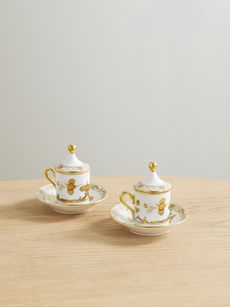 GINORI 1735Oriente Italiano set of two gold-plated porcelain coffee cups, covers and saucers
 CHRISTOFLEMood Coffee set of six silver-plated espresso spoons with chest
 THE ROWPonti velvet slippers$1,040.00View Product DetailsSelect a Size35 - out of stock36 - out of stock3737.5 - out of stock3838.5 - out of stock394041 - low stock42 - out of stock
The modern ritual
Where traditional rituals were communal and culturally embedded, modern ones are mostly individual. It’s about choosing a point of entry into the day and making that beginning feel deliberate and within your control. It doesn’t so much matter what practices are inherited, or what it signifies to anyone else, as much as carving out a moment to yourself. The focus on how your coffee is assembled, brewed, edited or aestheticized allows you to calm your mind and meditate on the morning ahead.
For some, that looks like precision and solitude. For others, something more social, aligned with enforced work boundaries. Julia White, a busy global lead at Tiktok, describes her own ritual with strict clarity: no coffee at home, no emails overnight. Instead, a deliberate pause after the school run, a specific flat white from a specific café, always in a specific cup, always with the lid on. “It grounds me. It starts the day off exactly how I want to start it,” she says. “It’s my little slice of heaven before the day really starts.”
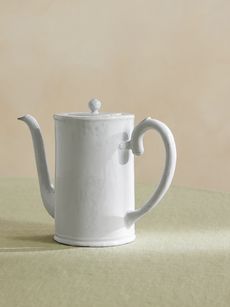 ASTIER DE VILLATTEColbert small ceramic coffee pot
 LOEWEPrinted jersey T-shirt$468.00View Product DetailsSelect a Sizex small - low stocksmall - low stockmedium - out of stocklarge - out of stockx large - out of stock
 COMME SILa Boxer Classica striped cotton-poplin shorts$74.00View Product DetailsSelect a Sizex small - out of stocksmall - out of stockmedium - out of stocklarge - out of stockx large - out of stock
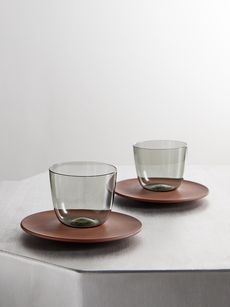 LOBMEYR+ MEISSEN set of two glass and stoneware espresso cups and saucers
For global sports television presenter Nicki Shields, the practice is multi-layered. She starts with ginger and lemon water and a specific regime of supplements – and then she begins on coffee. “A quiet, grounding ritual that transforms me from a slightly disheveled Neanderthal into a fully composed, super-mum ninja.” The humor is telling. Even here, there is an awareness of performance, but also of its vital function.
That tension between sincerity and performance is perhaps inevitable. “What you’re watching is probably the 20th take,” says Downing of the morning routines that populate our social-media feeds. “The healthiest thing you can do is watch them knowing that,” she adds. But what these videos actually signify is still important. “It’s doing something you love,” she says, “that makes you feel good – and doing it consistently.”
The vessel
“Routine is a collection of mundane tasks that are seen as drudgery,” says Deferio. “Ritual is an exploration of meaning in the task itself.” And, if you don’t know how to assign meaning to the task of making coffee, he suggests first exploring the container you’re making the coffee in.
“I match the cup with the mood – and even what I am drinking,” says Deferio. “Some lighter coffees feel best in handless ceramic cups, heavier-bodied coffee might be better in a vintage diner mug, another coffee might feel best in a 1970s Japanese stacking cup. I sit in front of my cabinet for a few moments, gauging the mood of both the day and myself and pick one that makes sense. It’s an art, not a science – and that’s the point. It’s part of the ritual.”
 ASTIER DE VILLATTE+ John Derian Darling ceramic teacup
 BOTTEGA VENETACashmere sweater$2,500.00View Product DetailsSelect a Sizexx smallx small - out of stocksmall - out of stockmedium - out of stocklarge - out of stock
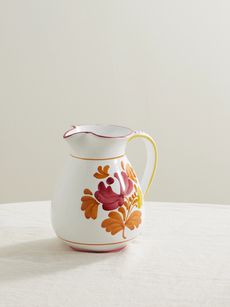 CABANABlossom painted ceramic jug
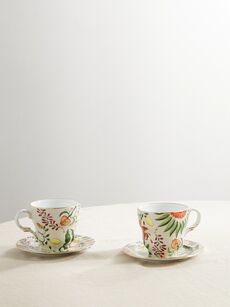 LA DOUBLEJSet of two gold-plated porcelain espresso cups and saucers
Beyond that, think about your bean selection, the order in which you lay out your utensils, the view you’re going to look at as you take your first sip and the way you’re going to organize your thoughts with the subsequent ones. It might be five minutes, it might be more – but, crucially, it’s what you can fit easily into your day.
In a culture shaped by automation and acceleration, where AI drafts our messages, algorithms anticipate our needs and productivity is very literally measured, the appeal of something deliberately inefficient is obvious. Making coffee by hand, or even simply sitting with it before the day begins, becomes an act of resistance.