The Return Of The Salon
A rebellion against the ‘everything rooms’ of open-plan living, the salon of 17th-century France is making a contemporary comeback as a space for intimacy and considered conversation. By NATASHA BIRD
Towards the front of the house, my son shrieks intermittently, his little body bopping up and down above our rust-orange sofa. He’s staring at the television screen, Playstation remote in hand, caterwauling every time a tiny purple dragon gets clubbed by a troll. At the business end of the house, my husband sits at our dining table, listening in on a Teams call on his laptop, while I play Doechii on my phone and pour stock into a risotto. The 1990s gave us many great things, including Sex and the City, Lancôme Juicy Tubes and Kate Moss world dominance, but I will never thank it for popularizing open-plan living.
Open-plan design fed us a myth of conviviality. Space-spanning joy and interaction, wherein all parties could converse and perambulate, partaking in pleasant companionship while getting on with different things. This might have worked in the 1950s, when the idea was first conceived, but in the era of attention deficit and maximum screen time, all it really inspires is sensory overload. “Open-plan living gave us the illusion of connection – you’re always slightly ‘on’: half-cooking, half-listening, half-scrolling,” says legal director and fashion and interiors tastemaker Thandi Maqubela.“Constant visibility isn’t the same as intimacy.”
“What interests me about the salon is that it represents a deep need for quiet, real, human connection”Justina Blakeney
The return of the salon is more than just a death knell for the ‘everything room.’ It’s a rebound to ritual, cultural exchange and the relationships that develop out of cossetted closeness. Originally emerging in 17th-century Paris, the salon was a private drawing room, often hosted by women, where artists, writers and thinkers could gather for discourse. By the 1930s, certain salons had found enormous fame (or notoriety), such as Elsa Schiaparelli’s at 21 Place Vendôme – a rarified space where fashion, art and ideas collided, and thinkers like Salvador Dalí and Jean Cocteau dabbled across disciplines. Architecturally, a salon supports eye contact and familiarity: doors that close; seats arranged to face one another or allow for break-out chats; layered textiles to soften acoustics; low lighting; and an accumulation of thought-sparking books, art and objets. A salon holds people; it doesn’t let them wander off to look at the garden. It brings back dark corners, where secrets can once again be whispered over wine.
“What interests me about the salon is that it represents a deep need for quiet, real, human connection,” says designer and artist Justina Blakeney. “It feels like the antidote to the oversharing era, creating a container for one experience at a time – conversation, music, reading or a drink with friends.” Exhausted by the pace of life and by moving around our spouses like ships passing in the night, we’re craving a fundamental shift. “A salon brings everyone onto the same level,” says Blakeney, “turning the volume of the world down and the volume of closeness up.”
A salon is also a serious status symbol. For decades, home spaces have necessarily been arranged as a catch-all solution for busy lives and frenzied, frenetic activity. One eye on the toddler and the other on your emails. “Smaller, enclosed spaces with atmosphere invoke a feeling of intimate decadence,” says Venetia Rudebeck, of Studio Vero. When most of us are fighting for a minute’s peace, owning a room just for conversation feels like an extraordinary extravagance. “It’s a very traditional idea, really,” says Rudebeck, “but right now it feels like a particularly modern luxury.”
Distinguishing a salon from a drawing or dining room is either an immediately obvious or very subtle art. Among the well-to-do, the salon exists additionally to both drawing and dining rooms, conspicuous on the grounds of its superfluity. For those who don’t have the square footage, turning an otherwise basic living space into a salon is in the detail. “You can create a salon anywhere by carving out space with purpose: layered seating, a rug that grounds it, and lighting that feels low and intentional. Pull the furniture inward to create a sense of enclosure, even in an open room. The goal is to signal that this is where we gather, not just pass through,” says Tamara Kaye-Honey of interiors collective House of Honey. “The single-sofa-facing-the-TV model is being dethroned. We’re seeing more chairs facing chairs; sofas that don’t dominate. For materials, anything that absorbs rather than reflects. Upholstery that invites touch: velvet, mohair, worn leather. Drapery that softens sound,” Kaye-Honey continues. “Even wood tones that feel warm rather than stark. Intimacy is sensory.”
“Dimmable lighting is essential throughout,” adds Irish designer Maolíosa Murray. “I love to use recessed spots and directional spots for artwork. Layering is also key: table lamps and floor lamps for reading by the sofa.”
 TRUDONCire scented candle, 3kg
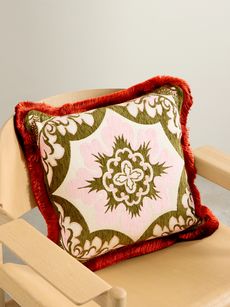 LA DOUBLEJFringed chenille-jacquard cushion
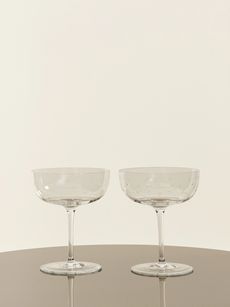 LOBMEYRRothschild Stars set of two crystal champagne cup
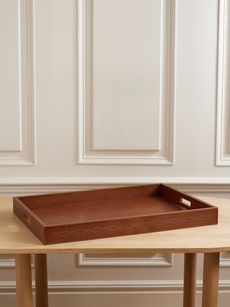 RALPH LAUREN HOMEBromley studded leather tray
The purpose of creating a salon-style space is to dictate behavior. Where open-plan living often gives way to distraction and fragmentation, the aim now is to engineer presence and depth. “We’re trying to counter how sprawling life has become by containing what we can,” says Maqubela. “A salon feels like an intentional space, where we can pause and disengage for a minute.” Think of the stilted, echoing conversation of a formal dinner party before the wine is in full flow, versus the ribald gossip you can engage in when everyone’s been allowed to peel off after dessert. “The most meaningful conversations almost always happen once you’ve migrated away from the main space,” Maqubela agrees.
Other than intimacy, we’re trying to inject some culture back into our lives. The last few years have been so dominated by the draw of social media, as we’ve vacillated between the performative behavior of posting and the mind-numbing dullness of doomscrolling. A salon, on the other hand, says dim the lighting, put your phone away, grab a Brontë novel, muse on an ethical dilemma, or tinkle some Prokofiev on the baby grand.
Ignoring privilege for a second (and definitely putting too fine a point on it), while streaming platforms compete for our last scraps of concentration, AI conflates creativity and robots threaten to become more sentient than we’re training ourselves to be, salons feel like part of a last stand. A quiet future for people to sit, think, chat and enjoy each other’s company.
DRESSING FOR THE SALON
Dressing for the salon is about movement, intrigue and directing the eye. Plunge yourself psychologically into the bougie sumptuousness of Schiaparelli’s Place Vendôme. Pick fluid silhouettes that allow you to waft around, then add a point of tension: a sculptural brooch, an unusual earring, something provocative to spark conversation.
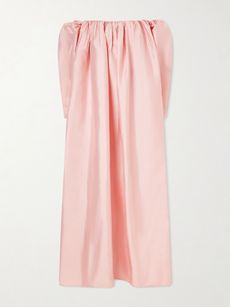 ABADIAEleanor off-the-shoulder taffeta gown$548.00View Product DetailsSelect a Size2 - out of stock4 - out of stock6 - low stock810 - out of stock12 - out of stock
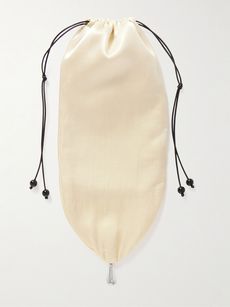 SOPHIE BUHAITeardrop embellished satin drawstring pouch
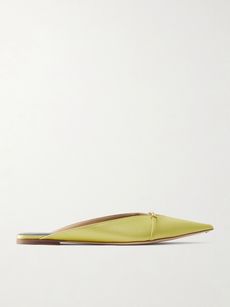 TOM FORDEmbellished satin slippers$463.00View Product DetailsSelect a Size3636.53737.5 - out of stock38 - out of stock38.539 - out of stock39.5 - out of stock40 - out of stock40.5 - out of stock41 - out of stock41.5 - out of stock42 - out of stock
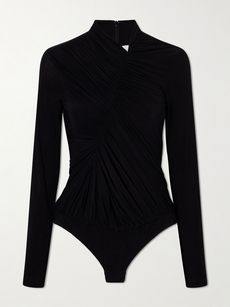 STELLA MCCARTNEYDraped crepe-jersey bodysuit$558.00View Product DetailsSelect a Size34 - low stock36 - low stock38 - low stock40 - out of stock42 - out of stock44 - out of stock
