The Glass Is The Occasion
Drinking cultures continue to evolve, but our sense of celebration has endured. From tall Murano glass to sculptural coupes, the new markers of occasion are less about the pour and more about what you pour it into. By NATASHA BIRD
Newlyweds take their place at the top table. We raise a glass. A eulogy full of pathos and reverence. We raise a glass. From highs to goodbyes, for all of life’s milestone moments, we love to raise a glass.
At the turn of the 20th century, it was a crystal coupe filled with Champagne – the aspirational middle-class libation of preference. As we reveled and rejoiced our way through the decades, prohibition gave us the snifters; a highball danced its way in. We introduced a flute for bubble retention, and the steeply conical martini glasses of the ’80s cocktail era became the peak of glitz and glamour.
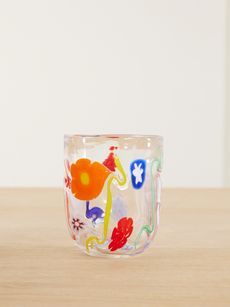 LAGUNA~BFantasia medium Murano glass
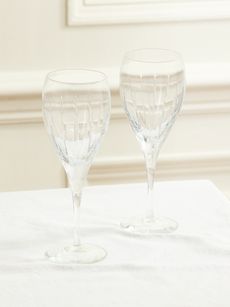 CHRISTOFLEIriana set of two crystal water glasses
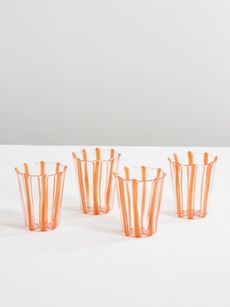 SOPHIE LOU JACOBSENLe Verre Bonbon set of four glasses
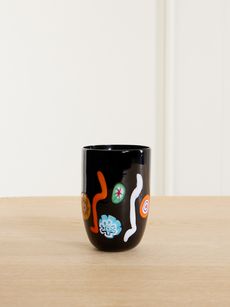 LAGUNA~BGoto large Murano glass
The beverage might have varied, and shapes have certainly experienced progressive metamorphosis, but in a way, the glass has always been central to occasion.
Culture is changing though. We’re drinking less, drinking differently, or not drinking at all. Alcohol consumption has reached its lowest level since data collection began in the ’90s. Gen Z, in particular, are drinking 20% less than the millennials of the generation above them. Which could mean that celebratory toasting is, well, toast.
Or is it? The rise and rise of ‘no/lo’ options, spurred on by the sober-curious movement, has presented us with a whole new drinks industry. From Seedlip and Botivo to Ghia and Clean Co., start-ups are producing delicious, spirit-adjacent liquids that can echo the cocktail and aperitif experience. Exclusively alcohol-free beer companies like Lucky Saint are growing 58% year on year. And those Gen Zs who we worried might be letting the bottom fall out of drinking culture? They’re dabbling in slower consumption, maybe, but they’re hosting soirees and dinner parties at pace. We’re celebrating more than ever, it seems. It’s just that Champagne isn’t necessarily the guest of honor. “Ceremony no longer depends on the drink itself, but on the gesture and the mise-en-scène,” according to storied French tableware maison Christofle. “The vessel becomes the true carrier of emotion.”
“I think etiquette and the rigid rules of traditional hosting have relaxed in the last few decades, making space for a more spontaneous and genuine, convivial approach,” says Caterina Capelli, head of communications at Laguna~B, a brand newly launched on NET-A-PORTER that specializes in designing and hand-blowing Murano glass. “Laguna~B glassware is really not conceived for specific occasions or specific types of drinks.”
“Dinner parties are no longer just social occasions, but opportunities for creative expression”Creative director and tablescape artist Omer Gilony
Of this era, one thing is for sure: just because it’s soft doesn’t mean we want it in a tumbler traditionally reserved for juice. Whether we’re sipping on vintage bubbles, a cocktail, kombucha, sparkling tea or a 0% adaptogenic aperitivo, for the special moments, we still want a sense of theater. “For a long time, abstinence was visually coded as absence…the slightly apologetic sparkling water,” says Completedworks artistic director Anna Jewsbury. “But culturally it’s shifted into something much richer. A coupe or tumbler no longer signifies what’s in it so much as the permission to pause, gather and participate.” The aesthetics of celebration matter more than ever.
Speaking of those dinner parties experiencing next-gen veneration, the rituals of hosting culture have found their most resplendent distillation here. “Dinner parties are no longer just social occasions,” says creative director and tablescape artist Omer Gilony, “but opportunities for creative expression.” Gilony, who also created her own glassware line with glass artist Lucie Claudia, has made a business out of staging the most sumptuous, imaginative tablescapes, many of which look straight out of a Willem Kalf still life, complete with iridescent fish heads, oyster shells and glinting pomegranate seeds strewn pointedly about. Beyond the fruit and fruits-de-mer, for Gilony, the vessels take center stage. “Glassware,” she says, “is both practical and deeply decorative; one of the few elements on the table that truly interacts with light and movement.”
These objects are now what carry the luxury. They are the signifier of occasion, which is why craftsmanship is king. “Weight, proportion, reflectivity,” lists Jewsbury, “the way light catches a stem or pools in a base.” Indeed, “material transforms the experience,” adds the Christofle team. “It captures light, engages the senses and reveals the drink.”
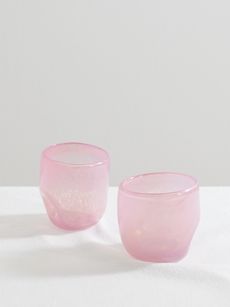 COMPLETEDWORKSThaw set of two recycled glass cups
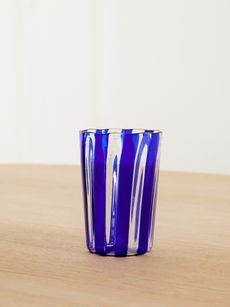 LAGUNA~BBerlingot large Murano glass
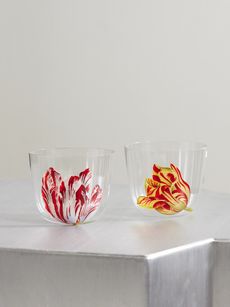 LOBMEYRTulipmania set of two painted crystal glass tumblers
While many of the start-ups listed earlier have infused fresh life and playful flavor into the no/lo spray, if the buzz is gone – the pleasurable texture of gentle intoxication – what takes its place? The tactility of the glasses themselves, perhaps, and the pageantry of raising them. “Our famously thin and featherlight glasses offer a pleasant lightness and cheerfulness,” says Leonid Rath, managing partner at centuries-old Viennese glassmaking house Lobmeyr. “We have to be even more refined when there is no alcohol.”
“The act of drinking turns into a sensory experience,” says Capelli. “Murano has a particular weight and consistency, which is a pleasure to hold in your hand.”
Traditional hosting rules are collapsing. Champagne flutes for kombucha (“of course,” insists Christofle), tumblers for tea, coupes for dessert, and enthralling tablescapes of found objects and mismatching everything, creating the heady experience we once relied on alcohol for. In the world of sober living, we still raise a glass. We simply expect more from the glass itself.
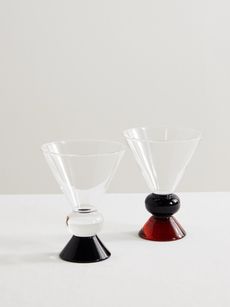 SOPHIE LOU JACOBSEN+ Ghia Totem set of two glasses
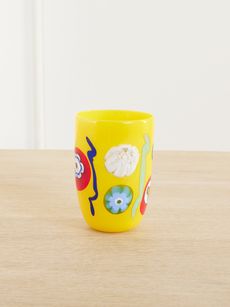 LAGUNA~BGoto large Murano glass
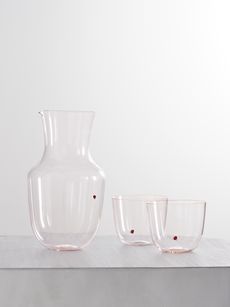 LOBMEYRAlpha set of two crystal glass tumblers and pitcher
